
The year is 2026, and the global economic landscape has dramatically reshaped how we shop for furniture. Relentless supply chain inflation, rising raw material costs, and currency fluctuations have pushed the price of luxury home goods to unprecedented heights. For homeowners in Malaysia—whether outfitting a sleek high-rise condo in Johor Bahru’s Medini or renovating a spacious bungalow in Klang Valley—curating a sophisticated interior requires far more financial strategy than it did a decade ago.
Among the most coveted items for modern interior design is the chaise lounge (historically known as the chaise longue). Associated with high society, classical elegance, and ultimate relaxation, this elongated seating piece serves as a breathtaking focal point in reading nooks, master bedrooms, and expansive living rooms. However, when buyers walk into a high-end retail showroom today, they are frequently met with a staggering reality: a single chaise lounge often costs significantly more than an entire three-seater sofa.
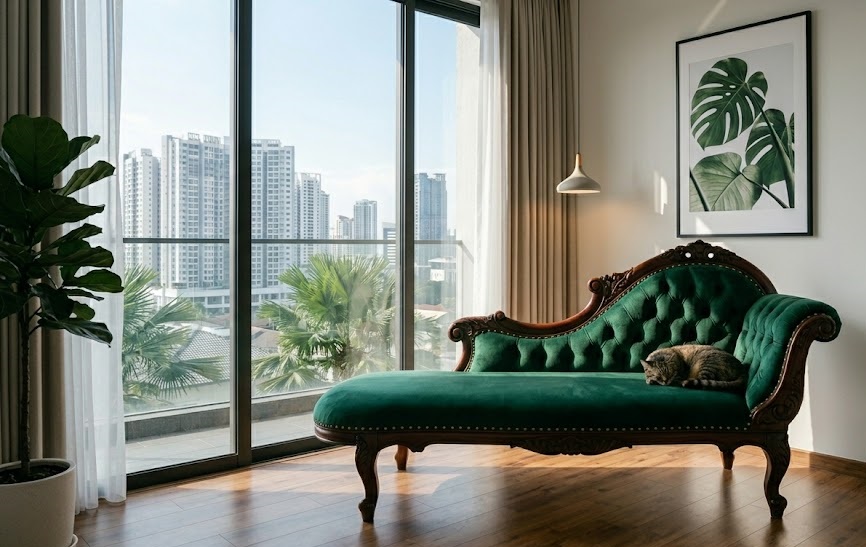
If you have ever stared at a price tag in disbelief, wondering why are chaise lounges so expensive, you are not alone. To the untrained eye, it appears to be half a sofa, lacking the full backrest and armrests of a traditional couch. Logically, less material should equal a lower price, right?
The truth is deeply rooted in structural engineering, specialized artisanal labor, and the brutal economics of low-volume retail manufacturing. In this comprehensive guide, we will peel back the curtain on the luxury furniture industry to explain exactly why this specific piece commands such a premium. More importantly, we will reveal how savvy homeowners in Malaysia are bypassing the inflated retail market by “cheating the system” and turning to a much smarter, sustainable investment.
Reason 1: The Nightmare of Asymmetrical Engineering
To understand the high cost of a chaise lounge, we must first look at its internal skeleton. A standard three-seater sofa is, functionally, a well-balanced box. It has four supportive corners, two identical armrests, and a straight, load-bearing backrest spanning the entire width. This symmetry distributes weight evenly, allowing mass-market manufacturers to use lighter, cheaper materials like engineered plywood or medium-density fiberboard (MDF) without immediate structural failure.
A chaise lounge is an architectural rebel. By design, it is entirely asymmetrical. It typically features only one armrest and a partial backrest that slopes off into nothingness. When a person reclines on a chaise, the physical stress and weight distribution are concentrated heavily on one side of the frame. The torsional stress—the twisting force exerted on the wooden joints—is immense.
To prevent the frame from snapping or warping under this uneven pressure, manufacturers cannot use cheap, mass-produced inner frames. A high-quality chaise lounge requires a meticulously engineered skeleton made from thick, kiln-dried solid hardwoods such as Teak, Acacia, or Mahogany. In Malaysia’s tropical climate, where high ambient humidity and frequent air-conditioning use create a constant cycle of expansion and contraction, using premium solid wood is non-negotiable.
Furthermore, standard metal brackets are insufficient for joining an asymmetrical frame. Artisans must utilize highly complex, time-consuming traditional joinery methods—such as double-doweling, corner-blocking, and mortise-and-tenon joints. This level of heavy-duty, customized structural engineering instantly doubles the raw material and labor costs before a single piece of fabric is even cut.
Reason 2: The Art of Specialized Upholstery
Another major factor driving up the cost of a chaise lounge is the intense manual labor required for its upholstery. When mass-producing a standard sofa, factory machines can quickly stretch fabric over straight, rectangular wooden boards. It is a highly mechanized, fast, and repeatable process.
Chaise lounges, however, are renowned for their sweeping curves, rolled arms, sloped backrests, and intricate deep-button tufting. You cannot simply pull a flat piece of velvet or top-grain leather over a complex 3D curve without it wrinkling, bunching, or warping. It requires the hands of a master upholsterer. The artisan must painstakingly cut, pleat, stretch, and hand-tack the fabric at highly specific tensions to conform perfectly to the sweeping lines of the frame.
If the chaise features patterned fabric—such as stripes, damask, or floral prints—the difficulty skyrockets. The artisan must ensure the pattern flows seamlessly across the asymmetrical backrest and down the length of the seating area. This precise pattern matching results in an immense amount of wasted “scrap” fabric, significantly increasing the raw material bill.
Furthermore, because a chaise lounge lacks a full backrest, the seating cushion itself bears the entirety of the user’s weight over a long, extended surface area. To prevent the seat from sagging over time, luxury chaises employ eight-way hand-tied coil spring systems, rather than cheap zigzag springs. Tying these springs by hand is a dying art form that requires hours of skilled labor, adding a massive premium to the final retail sticker price.
A chaise lounge requires a continuous, unbroken slab of high-density, multi-layered foam or a massive envelope of goose down that runs the entire length of the human body. Creating one massive, flawless cushion core is significantly more expensive than producing two or three separate, smaller seat cushions used on a traditional couch.
Reason 3: Low Volume Economics and the “Luxury Tax”
The final reason retail chaise lounges are so exorbitantly expensive boils down to basic supply and demand economics. In the furniture industry, factories thrive on economies of scale. If a manufacturer produces 10,000 units of a standard grey three-seater sofa, they can negotiate massive discounts on wood, fabric, foam, and shipping. The cost per unit drops drastically.
Chaise lounges, however, are considered niche, accent pieces. The average Malaysian family prioritizing functional seating for their living room will default to an L-shaped sectional or a standard sofa set. A standalone chaise lounge is a secondary luxury purchase. Because manufacturers sell far fewer chaises, they cannot produce them in massive, cost-saving batches. The production runs are small, keeping manufacturing costs extraordinarily high.
Additionally, chaise lounges command what the industry refers to as a “luxury footprint.” In a retail showroom in Kuala Lumpur or Johor Bahru, floor space is incredibly expensive. A chaise takes up nearly as much floor space as a small sofa, but appeals to a much smaller percentage of walk-in customers. To justify devoting that precious real estate to a slower-moving item, retailers apply a significantly higher markup. You are not just paying for the wood and the fabric; you are paying a premium for the piece’s inherent status as a luxury, statement item.
So, if the modern retail market is stacked against the consumer, heavily inflating prices through low-volume margins and complex modern production costs, how can you acquire this symbol of elegance without draining your savings?
The Cheat Code: Bypassing Retail with Premium Vintage
If modern retail environments are heavily stacked against the consumer—artificially inflating prices through low-volume margins, expensive luxury real estate footprints, and modern production overhead—how can a design-conscious homeowner in Malaysia acquire this ultimate symbol of elegance without entirely draining their renovation budget? The answer lies outside the polished, brightly lit showrooms of contemporary malls. The ultimate “cheat code” to owning a world-class chaise lounge is to bypass modern retail entirely and pivot your investment toward the premium vintage and antique furniture market.
In 2026, a massive shift is occurring in how high-net-worth individuals and savvy interior designers in Johor Bahru source their statement pieces. Rather than paying an exorbitant premium for a newly manufactured chaise lounge made with inferior, fast-growth wood and factory-stamped joinery, they are hunting for authentic, decades-old frames. The secondary market for antique luxury furniture is a treasure trove of unparalleled craftsmanship that modern factories simply cannot afford to replicate at a commercial scale today.
By purchasing a vintage chaise lounge, you are stripping away the “luxury showroom tax,” the international shipping overheads associated with contemporary global supply chains, and the modern marketing markups. Instead, you are paying strictly for the raw, intrinsic value of historical craftsmanship. To truly understand why this is the smartest financial maneuver for your home interior, we must delve deeply into the material science of historical furniture production and the lucrative economics of custom reupholstery in Malaysia.
The Lost Material: Old-Growth Timber vs. Modern Farmed Wood
The most profound difference between a chaise lounge built in 1960 and one manufactured in 2026 is the biological quality of the wood itself. Historically, master furniture makers utilized “old-growth” timber. These were trees harvested from deep, untouched forests that had grown slowly over centuries beneath dense forest canopies. Because they grew in highly competitive, light-restricted environments, the trees developed incredibly tight, dense growth rings.
Old-growth Mahogany, Teak, and Rosewood—the staple hardwoods of vintage luxury furniture—possess a cellular density that is vastly superior to almost anything available on the commercial market today. This high density makes the wood phenomenally strong, incredibly heavy, and naturally imbued with rich oils that repel moisture and wood-boring pests like termites. When an antique chaise lounge was built using this old-growth timber, its asymmetrical frame was given a foundation capable of surviving for centuries without warping or snapping under torsional stress.
Conversely, the modern furniture industry relies almost exclusively on “new-growth” or plantation-farmed timber. Driven by global demand and environmental regulations, these trees are bred to grow as fast as possible in open, sunlit plantations. They reach harvestable size in a fraction of the time, resulting in wide growth rings and a much softer, more porous cellular structure. While this makes modern wood cheaper and more sustainable to harvest, it lacks the raw, unyielding strength of its historical counterparts.
When you buy a brand-new chaise lounge from a modern retail store, even if it is marketed as “solid wood,” you are almost certainly buying fast-growth timber. It will be more susceptible to absorbing the high indoor humidity common during Johor’s seasonal monsoons, leading to microscopic expansions, joint loosening, and eventual structural failure. By investing in a vintage frame, you are securing a piece of old-growth structural integrity that is effectively extinct in modern commercial manufacturing.
The Financial Economics of Local Reupholstery
A common hesitation buyers have when exploring the vintage market is the aesthetic condition of the piece. Finding an antique chaise lounge with flawless, perfectly preserved upholstery that exactly matches your modern condo’s color palette is highly unlikely. The fabric may be faded, the foam may have degraded, or the pattern might feel hopelessly outdated. However, this is precisely where the financial “cheat code” activates.
The strategy is not to buy a vintage chaise for its fabric; the strategy is to buy it purely for its indestructible old-growth wooden skeleton and traditional spring system. Once acquired, you bring the piece to a skilled local upholsterer in Malaysia. Johor has a rich, thriving ecosystem of multi-generational artisanal upholstery workshops located in areas like Kempas, Plentong, and Tampoi. These local craftsmen possess the specialized skills to completely strip the chaise down to its bare wooden bones and rebuild the padding and fabric from scratch.
Let us break down the mathematics of this approach. A brand-new, high-end, custom-upholstered chaise lounge from an imported Italian or European design house can easily retail between RM 15,000 to RM 25,000. It carries massive import duties, currency exchange penalties, and showroom overheads.
Alternatively, you can source a structurally perfect vintage mahogany chaise frame for a fraction of that cost—often between RM 2,000 and RM 4,500. You can then purchase premium, imported high-performance fabric (such as stain-resistant velvet or top-grain semi-aniline leather) directly from a textile distributor. Handing the frame and your chosen fabric over to a master local upholsterer might cost an additional RM 2,500 to RM 4,000 in labor and high-density foam replacement.
The final result? For less than half the price of a generic, mass-produced retail luxury piece, you have secured a genuinely bespoke, heirloom-quality chaise lounge. It is custom-tailored to your exact interior design specifications, built upon a structurally superior old-growth frame, and supports local Malaysian craftsmanship. It is the ultimate manifestation of smart, sustainable luxury.
When having a vintage chaise reupholstered, always ask the artisan to inspect the original spring system. Antique chaises often feature authentic eight-way hand-tied copper coil springs—the absolute pinnacle of seating comfort and durability. Modern retail chaises frequently cut costs by replacing these with cheap zigzag wire springs or elastic webbing. A local upholsterer can simply re-tie the original antique coils, preserving a million-dollar seating feel that is almost impossible to find in new furniture today.
How to Spot a High-Quality Vintage Chaise Frame
To successfully execute this strategy, you must know how to separate a genuinely valuable antique frame from a poorly constructed reproduction. When hunting for vintage furniture, you need to act as an inspector, evaluating the piece not by its superficial fabric cover, but by its underlying architecture. Here are the critical checkpoints to evaluate before making a purchase:
1. The “Lift Test” for Density
The fastest way to judge the quality of a vintage chaise lounge is to physically lift one end of it. Old-growth solid hardwoods (like mahogany or teak) combined with heavy steel coil springs are incredibly dense. If the chaise feels shockingly heavy and difficult to maneuver, you have likely found a premium frame. If it lifts easily, feels hollow, or sounds resonant when tapped, it is likely constructed from mid-century plywood or a cheaper softwood, which will not survive the reupholstery process.
2. Inspecting the Joinery
Examine the areas where the wooden legs meet the main seating deck, and where the asymmetrical backrest attaches to the base. You are looking for signs of traditional joinery, specifically wooden dowels or mortise-and-tenon connections. These joints interlock the wood pieces perfectly, creating a bond stronger than the wood itself. Avoid pieces heavily reliant on visible metal brackets, modern Phillips-head screws, or excess dried glue, as these indicate a lower-quality, mass-produced reproduction that will quickly wobble under stress.
3. Checking for Wiggle and Torsion
Because the chaise lounge is an asymmetrical piece of furniture, it is highly prone to torsional stress. Stand firmly beside the chaise, grip the highest point of the sloped backrest, and apply firm, alternating pressure (pushing and pulling). The frame should feel entirely monolithic. If you hear squeaking, cracking, or feel the frame shift and flex beneath the fabric, the internal joinery has already failed. While an upholsterer can reglue joints, extensive structural frame repair will significantly eat into your budget.
4. Assessing Wood Damage vs. Patina
It is crucial to differentiate between beautiful historical patina and fatal structural damage. Surface scratches, minor dents, and faded varnishes on the exposed wooden legs or armrests are purely cosmetic; they add historical character and can be easily polished out or re-stained during the restoration process. However, look closely for tiny, clustered pinholes in the wood accompanied by fine sawdust (frass)—this is a sign of an active or historical wood-borer or termite infestation. Additionally, check the bottom of the wooden legs for dark, spongy rot caused by decades of mopping or high humidity. Severe rot or pest damage renders the frame useless.
Modern Retail vs. Restored Vintage: The Ultimate Comparison
To summarize the immense value gap between the two purchasing pathways, the following table provides a clear, side-by-side analysis of buying a brand-new retail chaise lounge versus sourcing and restoring a premium vintage frame.
| Evaluation Metric | Modern Luxury Retail Chaise | Restored Vintage / Antique Chaise |
|---|---|---|
| Frame Material | New-growth timber, engineered plywood, or MDF. | Old-growth solid hardwoods (Teak, Mahogany, Rosewood). |
| Structural Joinery | Metal brackets, staples, and modern industrial adhesives. | Hand-carved mortise-and-tenon, corner blocks, wooden dowels. |
| Seating Support System | Sinuous (zigzag) wire springs or elastic synthetic webbing. | Traditional eight-way hand-tied heavy gauge steel coil springs. |
| Customization Level | Limited to a pre-selected factory catalog of fabrics. | 100% Bespoke. You choose the exact fabric, foam density, and wood stain. |
| Overall Financial Value | High initial cost. Rapid depreciation the moment it is delivered. | Lower total cost. Appreciates in value as a restored historical artifact. |
| Environmental Impact | High carbon footprint (global shipping, mass manufacturing waste). | Zero manufacturing waste. Ultimate form of sustainable recycling. |
Styling a Vintage Chaise in a Modern Johor Apartment
A common misconception is that antique or vintage furniture belongs strictly in older, colonial-style bungalows or highly traditional settings. In the realm of 2026 interior design, this could not be further from the truth. In fact, placing a beautifully restored vintage chaise lounge inside a hyper-modern, minimalist high-rise condominium creates one of the most sophisticated aesthetic dynamics possible: the power of architectural contrast.
If you have recently moved into a sleek new development in Puteri Harbour or Mount Austin, your apartment is likely characterized by clean, straight lines, smooth glass balconies, polished stone floors, and neutral white or grey walls. While this modern aesthetic is undeniably clean and airy, it can quickly feel sterile, cold, or overly “cookie-cutter” if filled exclusively with similarly boxy, modern retail furniture.
A vintage chaise lounge acts as a brilliant disruptor. Its sweeping, asymmetrical curves and intricate, hand-carved wooden details inject immediate warmth, history, and organic softness into the rigid geometry of a modern room. To execute this look flawlessly, lean heavily into contrasting textures during the reupholstery phase. Consider wrapping an ornate, 19th-century mahogany frame in a stark, ultra-modern fabric like a matte charcoal performance linen, a bold mustard-yellow velvet, or even a sleek, minimalist white bouclé. This fusion of old-world architecture and contemporary textiles creates a striking, gallery-worthy statement piece that bridges the gap between past and present.
When it comes to spatial placement, leverage the unique low-profile nature of the chaise. Because it lacks a full-height backrest, a chaise lounge is the absolute perfect piece of furniture to place directly in front of floor-to-ceiling windows. It provides a luxurious spot to recline and enjoy your panoramic view of the Johor skyline or the Straits of Johor without physically obstructing the natural sunlight or blocking the visual flow of the room—a common issue when placing a standard, bulky sofa near a window.
The Final Verdict: A Smarter Way to Invest in Luxury
The exorbitant price tags attached to modern chaise lounges are not simply arbitrary retail greed; they are the unavoidable result of trying to mass-produce a highly complex, asymmetrical, and labor-intensive piece of architectural art in an era of automated, cost-cutting factory production. To build a chaise lounge properly requires expensive solid wood, complex joinery, and painstaking hand-upholstery—costs that the modern supply chain immediately passes on to the consumer, amplified by low-volume retail markups.
However, you do not have to play by the rules of modern retail inflation. By understanding the superior structural qualities of old-growth timber and leveraging the skilled labor of local Malaysian artisans, you can bypass the system entirely. Sourcing a high-quality vintage frame and commissioning a custom restoration is not just a clever financial loophole; it is a more sustainable, historically rich, and aesthetically superior approach to curating your home.
Are you ready to cheat the system and elevate your home interior with a genuine masterpiece? The journey begins with finding the perfect historical frame. We invite you to explore our exclusive antique and vintage collection. Discover beautifully preserved, structurally superior pieces waiting to be transformed into your bespoke, lifelong statement lounge.