
It is a universally acknowledged truth in 2026 that walking through an IKEA maze is only the beginning of your journey. The real test of endurance begins when you arrive back at your apartment—perhaps a newly minted condo in Johor Bahru’s bustling Mount Austin or a sleek high-rise in Danga Bay—staring down a pile of heavy, flat-pack cardboard boxes. For decades, the trade-off was simple: you save money on the purchase price, and in exchange, you invest your own sweat equity to put the pieces together. But as our lives become increasingly fast-paced, a critical question has emerged: is the DIY approach actually costing us more than we realize?
Welcome to the era of “fast furniture fatigue.” We are living in a time where the novelty of building your own bookshelf using a tiny, L-shaped Allen key has thoroughly worn off. Busy professionals, growing families, and young couples are beginning to calculate the true, hidden costs of DIY assembly. From the literal hours lost on a sunny Saturday afternoon to the intense psychological stress of deciphering wordless instruction manuals, the landscape of home furnishing is undergoing a massive shift. People are starting to recognize that their time is their most valuable asset, and spending it arguing over which wooden dowel goes into which pre-drilled hole is no longer a rite of passage—it’s a massive inconvenience.
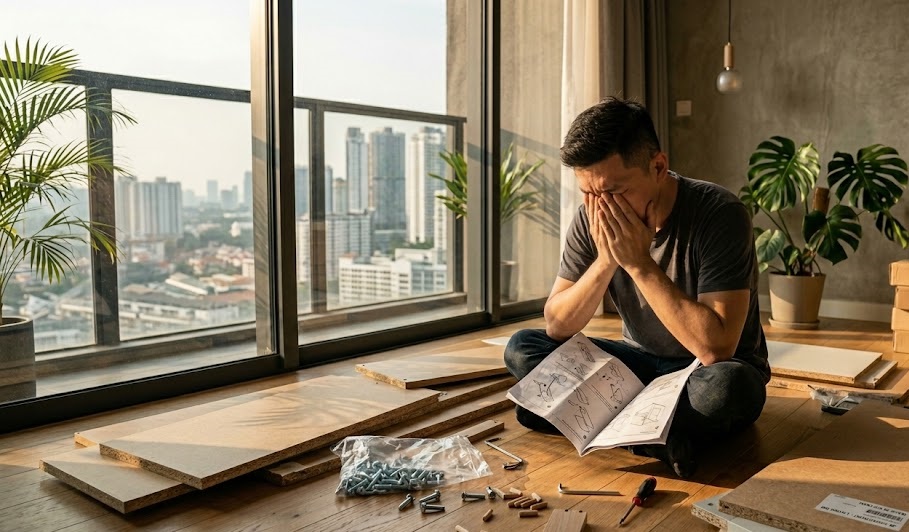
The Epidemic of Fast Furniture Fatigue
To understand the true cost of assembling your own furniture, we must first look at a phenomenon sweeping across modern households: fast furniture fatigue. Much like the fast-fashion industry, the fast-furniture industry relies on high turnover, trendy designs, and mass-manufactured materials. Flat-pack giants have optimized their supply chains to ship airless boxes around the globe, leaving the final, most labor-intensive step of the manufacturing process entirely in the hands of the consumer.
In the past, this was viewed as a charming, if slightly annoying, weekend project. You’d order a pizza, put on some music, and spend the afternoon building your new living room. But in 2026, the cultural narrative has shifted. Our work weeks are longer, hybrid working models have blurred the boundaries between the office and the living room, and the cognitive load of everyday life has never been higher. When a busy professional finally logs off for the weekend, the last thing they want to do is assume the role of an amateur carpenter.
This fatigue is particularly palpable in fast-developing urban hubs like Johor Bahru. With a surge of new residents moving into the city for cross-border work opportunities in Singapore, the real estate market is booming. New homeowners and renters are furnishing empty apartments at record speeds. But the reality of moving into a high-rise condominium quickly sets in when you are tasked with hauling 150 kilograms of compressed particleboard up an elevator, only to realize your Saturday is entirely booked with the assembly of a single three-door wardrobe. The sheer exhaustion of unboxing, decoding instructions, and manually driving dozens of screws translates into a massive loss of personal downtime. Fast furniture fatigue is the realization that the “cheap” price tag actually demands a heavy tax on your physical and mental well-being.
The Illusion of the “1-Hour Assembly”
If you have ever stared at the smiling, cartoonish figure on the front of a flat-pack instruction manual, you are familiar with the illusion of the quick assembly. These manuals are designed to look deceivingly simple, utilizing a universal language of illustrations to guide you through the process. However, this minimalist approach to instructions often obscures the complex reality of the build.
If you’re wondering how hard is it to assemble IKEA furniture, the answer is highly subjective but universally underestimated. What a professional assembler might complete in forty-five minutes with power tools and specialized experience can easily take a layperson three to four hours. The reasons for this discrepancy are manifold.
First, there is the issue of workspace. Flat-pack instructions assume you have a vast, empty, carpeted floor to lay out all your pieces symmetrically. In reality, most people are assembling furniture in the very room the furniture is destined for, surrounded by moving boxes, existing decor, and limited square footage. Navigating a tight Malaysian apartment while trying to flip a two-meter-long bookshelf without scratching the walls is a logistical nightmare.
The Hardware Sorting Dilemma
Before a single piece of wood is joined together, there is the infamous hardware sorting phase. A standard chest of drawers can come with upwards of 200 individual pieces of hardware: cam locks, wooden dowels, specialized screws, standard screws, tiny nails for the backboard, and hinges. Identifying the microscopic differences between screw #114321 and screw #114322 is not just tedious; it is fraught with risk. Using the wrong screw in the wrong hole can puncture the veneer of the furniture, causing irreparable aesthetic damage before the piece is even built.
Furthermore, missing parts remain a prevalent issue in 2026. Despite advancements in automated packaging, human and machine errors occur. Discovering you are short one crucial cam lock at step 45 of a 50-step process is a unique kind of heartbreak. It mandates a pause in the assembly, a trip back to the store (which, if you are living in JB and heading to Tebrau on a weekend, involves navigating heavy traffic), and waiting in line at the customer service counter. Suddenly, your afternoon project has bled into Sunday.
Calculating the True Financial Cost of Your Time
One of the most significant mindset shifts happening right now is how individuals calculate the value of their time. The primary motivation for purchasing flat-pack furniture has always been cost savings. But are you actually saving money?
Let’s do some basic math. Imagine a professional living in Johor Bahru whose time, based on their salary or freelance rate, is valued at RM 50 per hour. They purchase a large modular wardrobe system. The cost of the wardrobe itself is RM 1,800. The retailer offers a professional assembly service for RM 250.
The consumer decides to save the RM 250 and assemble it themselves. Between the unboxing, the sorting, the inevitable mistakes, dismantling those mistakes, and the final heavy lifting, the project takes them a grueling 8 hours over the weekend.
At RM 50 an hour, the consumer has just spent RM 400 worth of their own time to save RM 250. Furthermore, they end the weekend exhausted, stressed, and potentially with sore hands and an aching back. They didn’t get to spend time with their family, they didn’t get to rest, and they didn’t get to enjoy the weekend. When we factor in the opportunity cost of what you *could* have been doing with those 8 hours—whether that’s working a side hustle, enjoying local food in town, or simply recuperating from a long work week—the DIY route suddenly looks like a terrible financial investment.
When you opt for DIY flat-pack assembly, you aren’t just paying with your time. You are also subject to the “Assembly Tax”, which includes:
- Opportunity Cost: The loss of valuable weekend hours that could be spent on rest, family, or paid work.
- Physical Strain: Risk of back pain and blisters from manual screwdrivers and awkward lifting.
- Tool Investments: The need to buy power drills, rubber mallets, and proper screwdrivers because the included Allen key simply isn’t enough.
- Relationship Friction: The well-documented stress and arguments that frequently occur between couples attempting to decode instructions together.
The Durability Deficit: When DIY Assembly Goes Wrong
Beyond time and stress, there is a very tangible, physical cost to amateur furniture assembly: the durability of the final product. Flat-pack furniture is largely constructed from MDF (Medium Density Fiberboard) or particleboard covered in a thin veneer or foil. These materials are cost-effective and look great when brand new, but they are incredibly unforgiving of assembly errors.
In a tropical climate like Malaysia, humidity plays a massive role in the lifespan of your furniture. If joints are not tightened properly, or if screws are driven in at a slight angle, it creates microscopic gaps. Over time, the high humidity in the air can penetrate these gaps, causing the exposed particleboard inside to swell, warp, and ultimately degrade.
Professional assemblers know exactly how much torque to apply to a cam lock. They know that a backboard isn’t just a flimsy piece of cardboard to keep dust out—it is structurally integral to the rigidity of the entire unit. When amateurs assemble furniture, they often skip nailing in every single brad nail on the back panel to save time, or they fail to ensure the frame is perfectly square before securing it. This leads to wardrobes that lean to one side, drawers that scrape against their runners, and bookshelves that wobble ominously every time a heavy book is placed on them.
If a piece of furniture breaks down after two years because it was poorly assembled, you will find yourself back at the store buying a replacement. In this scenario, the hidden cost of DIY assembly is the literal cost of replacing the item prematurely.
The Psychological Toll: Couples, Stress, and the “Allen Key Arguments”
There is a well-documented psychological phenomenon often jokingly referred to in modern relationship therapy: the “IKEA argument.” Moving into a new home is already consistently ranked as one of the most stressful life events a person can experience. When you combine the exhaustion of moving boxes, the financial strain of securing a new property, and the sheer physical fatigue of a transition, you are already operating at a deficit. Introducing the complex, highly frustrating task of building your own furniture into this volatile mix is practically a recipe for domestic friction.
Picture the scene: It is a humid Saturday evening in Johor Bahru. You and your partner have just spent the entire day coordinating with movers and unpacking kitchenware. You are exhausted, but you still need a bed to sleep on. You drag the impossibly heavy flat-pack boxes into the master bedroom. You rip open the cardboard, unleashing a flurry of styrofoam beads that instantly cling to everything due to static electricity. Then, you open the manual. By step 14, one person is convinced the wooden dowel goes into the left panel, while the other is absolutely certain the illustration implies the right panel. Voices raise. Frustrations boil over. The “Allen Key Argument” has officially begun.
In the early 2010s, psychologists identified a cognitive bias known as the “IKEA Effect,” which suggested that consumers place a disproportionately high value on products they partially created themselves. The theory was that building a bookshelf gave you a sense of pride and ownership. However, in 2026, as our tolerance for unnecessary stress plummets, this effect is rapidly fading. The modern consumer no longer views DIY assembly as a proud accomplishment; they view it as an unpaid second job. The psychological toll of navigating confusing instructions, correcting agonizing mistakes (like installing drawer runners backward and having to dismantle the entire frame), and dealing with the physical aches of assembly drastically outweighs any lingering sense of DIY pride.
The Anatomy of a Flat-Pack Mistake
To truly understand the stress involved, we have to look at the anatomy of a flat-pack mistake. Unlike traditional carpentry where you can measure twice and cut once, flat-pack furniture assembly is a linear, unforgiving sequence. If you misinterpret an illustration on step 3 of a 60-step manual, you might not realize your error until step 58, when the final roof panel simply refuses to align with the pre-drilled holes.
At this point, you are faced with a demoralizing choice: force the piece into place—thereby compromising the structural integrity and potentially snapping the MDF—or meticulously undo an hour’s worth of work to fix the original mistake. This specific brand of frustration is unique to DIY assembly. It drains your mental energy and turns what should be an exciting moment of home decoration into a grueling test of patience. The hidden cost here is your peace of mind.
Structural Integrity and the Tropics: A Malaysian Perspective
Beyond the immediate stress and time investment, the most severe hidden cost of DIY assembly is the long-term durability of the furniture. We touched on this earlier, but it demands deeper exploration, particularly for consumers living in tropical climates like Malaysia. The structural integrity of flat-pack furniture is inherently fragile. It relies entirely on the precision of the assembler.
When a professional builds a piece of furniture, they apply exactly the right amount of torque to the cam locks. They ensure that every single backboard nail is driven straight, reinforcing the 90-degree angles of the frame so that the wardrobe doesn’t eventually lean to the left or right (a phenomenon known as “racking”). Amateurs, fatigued by hour three of the build, often cut corners. They might leave a few screws slightly loose or skip hammering in all the backboard nails because it seems tedious.
In a climate like Johor Bahru, where the ambient humidity regularly exceeds 80%, these tiny assembly errors become fatal flaws. When joints aren’t perfectly tight, the humid air seeps into the unprotected, un-veneered edges of the particleboard. Over a few short months, the wood fibers absorb this moisture and begin to expand. This swelling causes the veneer to peel, the joints to weaken further, and the doors to misalign. Once the MDF has swollen, the damage is irreversible.
Furthermore, Malaysian homes frequently transition between intense tropical heat and the cold, dry air of air-conditioning units. This constant fluctuation causes materials to subtly expand and contract. If a piece of furniture is professionally assembled with high-quality glues and expertly tightened fixtures, it can withstand these environmental pressures. A loosely assembled DIY bookshelf, however, will begin to wobble, creak, and eventually fail. The hidden cost of an amateur build is a drastically reduced lifespan for the furniture, meaning you will be forced to replace it—and build it again—far sooner than you anticipated.
| Factor | DIY Flat-Pack Assembly | Professional Assembly / Pre-Built |
|---|---|---|
| Time Investment | High (3 to 8+ hours per major item, plus shopping and transit). | Zero. You spend your weekend relaxing or working on your own terms. |
| Stress Levels | High. Prone to manual-induced confusion, physical strain, and relationship arguments. | Minimal. White-glove delivery handles everything from start to finish. |
| Structural Durability | Inconsistent. Dependent on the user’s skill, patience, and adherence to instructions. | Maximum. Assembled exactly to manufacturer specifications for a longer lifespan. |
| Hidden Financial Costs | High opportunity cost (lost wages/time), potential tool purchases, and premature replacement. | Upfront transparency. You pay for quality and convenience once, saving money in the long run. |
| Cleanup & Disposal | Requires breaking down massive amounts of heavy cardboard and styrofoam for the JMB. | Zero. Professional services usually remove all packaging materials upon departure. |
The Hidden Costs of Tools, Hardware, and Clean-Up
When calculating the cost of assembling IKEA or similar flat-pack furniture, consumers rarely factor in the peripheral expenses. The brochure implies that all you need is the tiny metal Allen key provided in the box. Anyone who has ever built a six-drawer dresser knows this is a spectacular understatement.
To properly and painlessly assemble modern flat-pack furniture, you need an arsenal of tools. A high-quality ratcheting screwdriver is essential to prevent severe blistering on your palms. A rubber mallet is often required to tap wooden dowels into place without shattering the surrounding veneer. For larger projects, a low-torque electric drill is practically mandatory to save hours of manual wrist-turning. If you do not already own these tools, your supposedly “cheap” DIY furniture just cost you an additional RM 150 to RM 300 at the local hardware store.
Cardboard Mountains and the Logistics of Disposal
Then, there is the aftermath. You have successfully built your television console. You are sweaty, tired, and ready to sit down. But before you can relax, you have to deal with the mountain of packaging material left behind. Flat-pack furniture requires an extraordinary amount of dense cardboard, rigid styrofoam blocks, and plastic wrapping to survive the global shipping process.
If you live in a modern high-rise in Malaysia, disposing of this waste is not as simple as tossing it in a bin. Most Joint Management Bodies (JMBs) have strict rules regarding bulky waste. You cannot simply shove intact television-stand boxes down the garbage chute. You must spend an additional 45 minutes using a box cutter to break down thick, double-walled cardboard into manageable squares, bag up the statically charged styrofoam that has coated your living room floor like a light snow, and haul it all down to the specialized refuse room in the basement. This exhausting cleanup phase is the final hidden tax on your time and energy.
Professional delivery and assembly services don’t just build the furniture; they reclaim your living space. The true luxury of avoiding DIY assembly isn’t just skipping the build—it’s watching the delivery team walk out of your door carrying every single piece of trash, leaving you with nothing but a flawless, ready-to-use piece of furniture.
Shifting Trends: Why 2026 is the Year We Stop Building Our Own Furniture
The consumer landscape in 2026 is defined by a deep desire for convenience, quality, and time-optimization. We have normalized the outsourcing of almost every minor inconvenience in our lives. We use apps to have our groceries delivered, our meals cooked, and our homes cleaned. It is completely illogical that, in an era of unprecedented convenience, we are still willing to spend our precious weekends kneeling on a hard floor wrestling with cam locks and particleboard.
Fast furniture fatigue has reached a tipping point. Consumers are recognizing that the “IKEA model” of shifting the final manufacturing labor onto the buyer only benefits the massive corporations, not the end user. As a result, there is a massive resurgence in the demand for fully assembled, high-quality furniture, as well as premium delivery services that handle the assembly on-site before they leave.
This shift is particularly prominent among millennials and older Gen Z consumers who are buying their first homes or upgrading their living spaces. They have lived through the era of disposable furniture that barely survives a single move. Now, they are prioritizing investments. They want solid constructions, beautiful finishes, and, most importantly, a seamless purchasing experience. The modern homeowner views their time as their most valuable currency. Why spend ten hours of that currency building a mediocre wardrobe when you can invest in a superior product that arrives ready to use?
Conclusion: Is It Time to Retire Your Allen Key?
The allure of cheap, flat-pack furniture is undeniably powerful. When you walk through a brilliantly illuminated showroom, looking at perfectly staged rooms, the price tags seem like an incredible bargain. But as we have explored, those price tags are deeply deceptive. They do not account for the weekend hours stolen from you, the agonizing stress of decoding wordless manuals, the physical toll on your hands and back, or the inevitable arguments that arise when a build goes wrong.
Furthermore, they don’t account for the durability deficit. A piece of furniture that is poorly assembled by an exhausted amateur will not survive the test of time, particularly in the unforgiving humidity of a Malaysian climate. The hidden costs of IKEA assembly and the broader fast-furniture market are ultimately paid by the consumer in the form of premature replacements and lost weekends.
As we navigate 2026, it is time to redefine what constitutes a “good deal.” A good deal is no longer just the lowest price at the checkout counter. A good deal is a purchase that enhances your life without draining your energy. It is a piece of furniture that is built to last, constructed by professionals, and delivered to your home without requiring you to lift a single screwdriver. By acknowledging the hidden costs of DIY assembly, we can make smarter, more sustainable choices for our homes and our well-being.
It is time to permanently retire the Allen key. Your weekends are worth far more than the money you “save” wrestling with flat-pack boxes. If you are tired of the flat-pack struggle and want to elevate your home with beautifully designed, stress-free furnishings, it’s time to upgrade your shopping experience. Leave the heavy lifting and the complicated manuals behind, and discover pieces that are truly ready for your life. Ready to reclaim your time and transform your space? Browse our premium, hassle-free collections and visit our shop today to find the perfect addition to your home.